He held up his phone to show us a clip from a reportage filmed by Sharjah TV in the 80s. An elder man was demonstrating handbuilding a pot through the coiling method in his modest stone workshop. “That’s my great grandfather, may he rest in peace” he beamed slightly.
Ali Alshemaili had invited us to view his family’s collection of centuries-old pottery, and exchange conversations on how he plans to revive this practice that went dormant a few decades ago. Beside him stood his cousin Mohammed, and together, along with the person whose domestic museum space we were standing in, also called Mohammed, and the late Salem Ahmed Al Haimar, they formed a group of cousins who took it upon themselves to restore, archive, relearn, and showcase this practice.
Ali was quick to credit Mohammed Abdullah Hassan for preserving many of the surviving pieces made by the tribe. Over the years he has collected pottery produced by previous generations and housed it in his private museum, creating a place where both visitors and local families can reconnect with a history that may have otherwise disappeared.
We had coordinated this day with the help of Ahmad Jalil, a professional mountain guide who has been instrumental in co-leading experiences where food, landscape, history, and culture meet via the work that I produce. We were thinking about producing a series of guided trails accompanied by a menu in areas where pottery practices were dominant. Until recently our approach to these areas was trying to reveal a part of history whose chapter is closed. On one of his subsequent guided trails, Ahmed met Ali, and serendipitously discovered that a continuation to that story is being written.
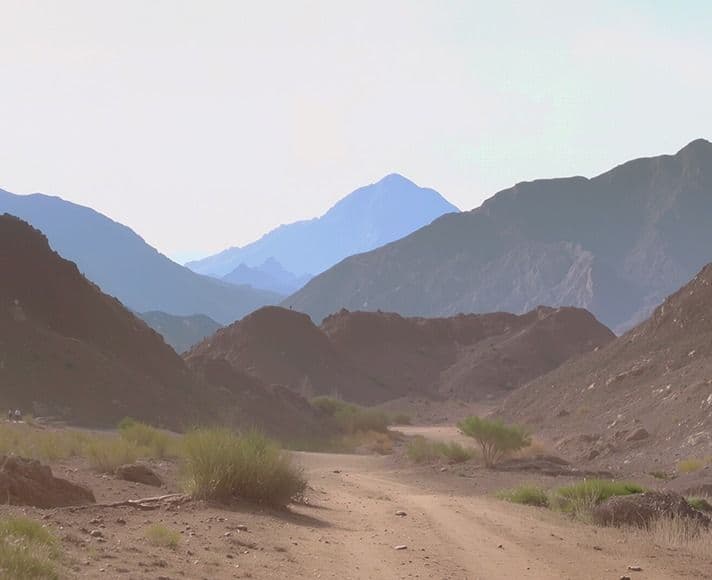
Alshemaili tribe hails from the mountains of Ras Alkhaima. For centuries, they have been creating functional and decorative objects out of the clay available to them from the mountains they lived in. With the advent of convenience brought by modernity, this form of creation began to stall in the 1960s, before coming to a halt shortly after.
“We are faced with the challenge of knowledge gaps in older generations, because the ones who practiced have passed, and the ones that preceded them had stopped practicing”. Ali remarked.
Just then Mohammed walked in with some freshly brewed coffee and spoke about the same challenge. What remains of the craft now exists in the memories of their elders; the names of the vessels, their uses, the clay sources, and the locations of the kilns.
"My grandfather was the first person who told me about it."
He told Ali about the history of the craft, about the old kilns in Wadi Haqeel, and about the workshops that once operated in the area. Eventually he took him to see them for himself.
"I remember seeing the kilns for the first time." He paused.
"It made me proud. The idea that my ancestors were part of the history of this craft in the region and across the Gulf for centuries."
The revival did not begin as a shared project. Each person arrived at it in their own way. One heard about it from a grandfather. Another through conversations with elders. A third was drawn to the old kilns and what remained of them.
"Each of us started on our own. Then the craft brought us together."
Because the craftsmen were no longer there, they had to relearn almost everything.
"We asked our elders about the process, the clay sources, and the names of the vessels. Then we started experimenting."
Ali smiled.
"This is what makes the craft special to me. It depends on cooperation."
He explained that it was no different in the past. Every craftsman had someone assisting him. Everyone had a role. On firing days, people gathered around the kilns together.
“There used to be 20 kilns in this area, but we can only count 6 now, we suspect the rest have been filled up and buried” Ali informed.
We pointed to a more well put together workshop, he remarked that it belongs to a distant family member, and that even though they are mostly related to each other in this area, he still approaches clay extraction mindfully so as not to overstep in anyone’s territory.
“How old are you guys?” I asked, hoping I wouldn’t be prompted to guess.
“Guess!” they both said.
“I’m going to assume you’re both in your twenties” I sighed, easily defeated.
They laughed and said they’re in their mid twenties and early thirties respectively.
I thought about the effort it takes for them to try to connect the dots while being within an age bracket with increasing life demands. The pressures of their endeavour is alleviated by their support of each other. As cousins, they know how to navigate their plan together.
Back inside the majlis, Ali handed us a wedged piece of clay, and we tried our best to follow instructions while handbuilding a pot.
With the last cups of coffee handed out by Mohammed already sipped and emptied, it was time to part ways, but only briefly.
“We hope the craft continues and never disappears again.” Ali returned to this thought more than once throughout our conversation.
“It reflects the history of people on this land. It shows how they used the environment around them and created something that lasted for centuries.”
The cousins have already done the difficult part. They have reconnected threads that were broken. What they are searching for now is not simply a revival of the craft, but a way to ensure it remains alive long enough to reach someone else, just as it once reached them through the memories of their elders.
We left doors open for future opportunities that could help support the cousins’ efforts in preserving and sharing their heritage.